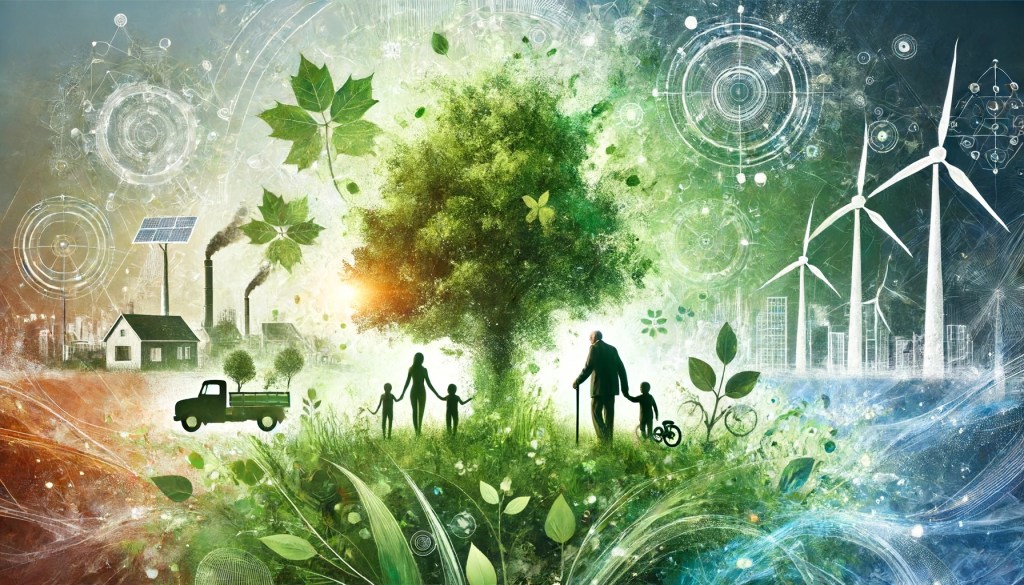
At times, I find myself immersed in a poignant parable, envisioning a nursing home where the echoes of laughter belong to the elderly versions of my own children; individuals who have, in turn, birthed children and grandchildren. Within this imagined future, I witness a tender scene of familial bonds, as the elder me welcomes visits from these descendants, now navigating the spectrum of age.
In this whimsical tapestry of time, the affection I feel for my children’s grandchildren becomes palpable, their playful presence creating an enduring connection that transcends the temporal boundaries of the present. The floor of this envisioned nursing home becomes a stage for generational joy, a testament to the interconnectedness of lives through the passage of time.
Yet, as I revel in the warmth of this familial embrace, my thoughts journey forward, contemplating the state of the world seven decades hence. Will the landscapes of Africa south of the Sahara still pulse with life? Will the rhythmic heartbeat of Bangladesh continue, or will it find new rhythms in different corners of the globe? Questions linger about the fate of those who may have migrated – where have they sought refuge, and what upheavals have accompanied their mass movement?
In the canvas of my imagination, I sketch a world shaped by the dual forces of progress and peril. Can technology, that elusive conjurer of solutions, have birthed mechanisms capable of extracting carbon from the atmosphere, alleviating the burdens of climate change?
Yet, amid these musings, a sobering truth surfaces: the uncertainty that shrouds the narrative of our collective future. The intricacies of this imagined world remain elusive, and we grapple with unanswered questions. Have our technological innovations truly outpaced our environmental negligence? Will the specter of a world suffocating under the weight of carbon linger as an indelible legacy?
In the contemplative spaces where reality meets dreams, a singular reality emerges: the responsibility we bear for the world that our progeny will inherit. It is a responsibility not merely to dream of miraculous solutions but to actively shape a trajectory toward their realization.
In the parable of potential pain, we wield the pen, architects of a narrative yet to unfold. Armed with knowledge and clarity, the path to avert the impending anguish is laid bare. The steps are known, the journey well defined, yet the hesitancy to embark upon it lingers in the currents of collective will. This parable serves as a mirror, reflecting the faces of our descendants—those who will tread upon this Earth long after our voices have faded. As we stand at the crossroads of possibility and apathy, the quill awaits our decisive strokes, eager to etch the chapters of our shared destiny.
[Published in Telicom: The Journal of the International Society for Philosophical Enquiry, 36, No. 1, page 81; image by Dall*E2]
 eudaimon.dk
Leave a comment